This miniature Kaleider screen can be clicked to view a larger image (see the rendered results below by the Mirroring item) =>

|
Kaleider manipulates images (and videos) to emulate various Kaleidoscope,
Mirroring, 3D Mirroring and Funneling effects. Effects can be controlled
manually to create particular desired results, or patterns can be automatically,
randomly generated to provide a fascinating, ever-changing display of colors and
image fragments. The Shifting/Wandering Effects feature adds dynamic
motion to graphics, and Rooms provides 3D depth perspectives to the display
of Kaleider patterns. The Mask/Mandala option merges a static
background with changeable, evolving patterns to produce interesting composite
images. Effects can be accompanied by music from the Audio
Player. Kaleider display sequences can be captured to
Video, and actions can be Scripted to create choreographed
performances of dynamic art.
This miniature Kaleider screen can be clicked to view a larger image (see the rendered results below by the Mirroring item) => |
|
Click for a description of the latest enhancements: Kaleider 5.8
The features offered by Kaleider are summarized below:
 Various
Kaleidoscope types can be selected, positioned on the screen, resized as
desired, and then rendered. These Kaleidoscope varieties are available:
Various
Kaleidoscope types can be selected, positioned on the screen, resized as
desired, and then rendered. These Kaleidoscope varieties are available:
 The Mirroring feature of Kaleider emulates generic mirrored surfaces
defined within rectangle, diamond, right triangle or equilateral triangle shaped
boxes. It can often produce effects with unusual symmetries.
The Mirroring feature of Kaleider emulates generic mirrored surfaces
defined within rectangle, diamond, right triangle or equilateral triangle shaped
boxes. It can often produce effects with unusual symmetries.


<= The images shown here were rendered from the Equilateral Triangle Mirror Pattern chosen in the sample screen shown at the top of this page.
These examples also illustrate the use of the Shifting Effects feature, in which the initial rendered image can be clicked and dragged with the mouse to dynamically re-render the effect based upon different relative positions within the source image. In this case, the Center option (on Edit Tools) has been set to automatically maximize effect symmetries. Then the underlying source image was 'virtually' shifted until pictures that looked interesting were formed. The 2nd image illustrates how the Adjust Controls can be used to interactively adjust the position, scale and rotation of rendered Tiles. These are just 2 samples of the nearly unlimited variations that are possible of the same effect on the same image!
It is also possible to produce interesting distortions of mirrored effects by
applying Mirror Transforms, which
can alter the reflection properties of Mirrors in unusual ways.
 emulate reflection from shiny surfaces that have curvature. Spherical,
Ellipsoidal and Cylindrical mirrors are like adjustable fragments of larger
reflective balls, eggs and columns. A Skewed Cone mirror reflects from a
distorted conical shape. Rippled mirrors resemble the concentric waves
that occur when a pebble is dropped into a calm pond. A collection of Fun
House mirrors create distortions similar to novelty mirrors in an amusement park.
emulate reflection from shiny surfaces that have curvature. Spherical,
Ellipsoidal and Cylindrical mirrors are like adjustable fragments of larger
reflective balls, eggs and columns. A Skewed Cone mirror reflects from a
distorted conical shape. Rippled mirrors resemble the concentric waves
that occur when a pebble is dropped into a calm pond. A collection of Fun
House mirrors create distortions similar to novelty mirrors in an amusement park.
 feature of Kaleider creates 'infinite reflection' effects similar those seen when
two mirrors face each other. A Funnel of a particular shape can be
selected, sized and positioned as desired, and then rendered to replicate an enclosed
portion of the image, with ever diminishing size, toward the center of the shape.
Rendered Funnels can optionally be tiled kaleidoscopically across the
screen. The available Funnel shapes are:
feature of Kaleider creates 'infinite reflection' effects similar those seen when
two mirrors face each other. A Funnel of a particular shape can be
selected, sized and positioned as desired, and then rendered to replicate an enclosed
portion of the image, with ever diminishing size, toward the center of the shape.
Rendered Funnels can optionally be tiled kaleidoscopically across the
screen. The available Funnel shapes are:
 Mirror, 3D Mirror or Funnel) can be stored as a Sequon. A Sequon can
later be applied to recreate the exact same effect with any source image, optionally
scaled appropriately for source images of different sizes. Sequons can
also be included with Random Effects and Automatic Effects.
The Sequons feature makes it possible to develop a library of your favorite,
most often used effects.
Mirror, 3D Mirror or Funnel) can be stored as a Sequon. A Sequon can
later be applied to recreate the exact same effect with any source image, optionally
scaled appropriately for source images of different sizes. Sequons can
also be included with Random Effects and Automatic Effects.
The Sequons feature makes it possible to develop a library of your favorite,
most often used effects. In addition to standard images Video Files, Video Devices (webcams,
camcorders, TV tuners, etc.) and Image Sequence animations can be used to provide
moving input for Kaleider effects. A Video File, Video Device or Image
Sequence can be opened much like a normal image file, and will be displayed and played
in the main Kaleider window. A small Movie Controls panel is available at the upper right corner
of the screen to control how the Movie is played. Kaleider effects
can then be selected and rendered as usual. Rendered effects will be continuously
updated with each Movie frame.
In addition to standard images Video Files, Video Devices (webcams,
camcorders, TV tuners, etc.) and Image Sequence animations can be used to provide
moving input for Kaleider effects. A Video File, Video Device or Image
Sequence can be opened much like a normal image file, and will be displayed and played
in the main Kaleider window. A small Movie Controls panel is available at the upper right corner
of the screen to control how the Movie is played. Kaleider effects
can then be selected and rendered as usual. Rendered effects will be continuously
updated with each Movie frame. converts the display into a 3D environment, with Kaleider effects plastered
onto the walls, ceilings and floors of various Rooms. Randomly
placed and sized Bubbles, also coated with Kaleider patterns, can appear
within Rooms. Room scenes can optionally be split into Dual
and Quad Views. Keyboard commands can be used to navigate around
the Rooms, or Roam can be toggled on to automatically zoom through
Rooms, make turns, bounce off walls, etc.
converts the display into a 3D environment, with Kaleider effects plastered
onto the walls, ceilings and floors of various Rooms. Randomly
placed and sized Bubbles, also coated with Kaleider patterns, can appear
within Rooms. Room scenes can optionally be split into Dual
and Quad Views. Keyboard commands can be used to navigate around
the Rooms, or Roam can be toggled on to automatically zoom through
Rooms, make turns, bounce off walls, etc.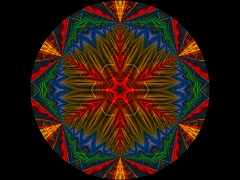 can overlay portions of the screen with a background, based on either a specified
Mask Shape or a Stencil image. The background areas can be
filled with either a solid color or another image. A Mandala is a
circular Mask with the background typically set to a solid color.
The Mask/Mandala Options screen is available to configure the
characteristics of Masking. It is possible to create custom Mask
Stencil images with the Create Mask function.
can overlay portions of the screen with a background, based on either a specified
Mask Shape or a Stencil image. The background areas can be
filled with either a solid color or another image. A Mandala is a
circular Mask with the background typically set to a solid color.
The Mask/Mandala Options screen is available to configure the
characteristics of Masking. It is possible to create custom Mask
Stencil images with the Create Mask function. Surfaces. Click the
  button on the Edit Tools panel (or type F10) to toggle on/off
the currently selected non-flat Surface. Right-click
to access a popup menu of Surfaces to choose from. Other than the
standard Flat Surface, effects will tend to appear distorted when tiled
over a Surface, sometimes rather drastically.
button on the Edit Tools panel (or type F10) to toggle on/off
the currently selected non-flat Surface. Right-click
to access a popup menu of Surfaces to choose from. Other than the
standard Flat Surface, effects will tend to appear distorted when tiled
over a Surface, sometimes rather drastically.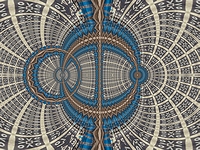 uses a Phase Plotting technique to apply effect tiles along the contours of
complex variable functions. (A complex number is composed of both real and
'imaginary' parts.) Click the
uses a Phase Plotting technique to apply effect tiles along the contours of
complex variable functions. (A complex number is composed of both real and
'imaginary' parts.) Click the  button on the Kaleid Tools panel (or
type F12) to toggle Mapping on/off. Right-click to
access the Mapping Menu, which provides a selection of Complex Variable
Functions to choose from.
button on the Kaleid Tools panel (or
type F12) to toggle Mapping on/off. Right-click to
access the Mapping Menu, which provides a selection of Complex Variable
Functions to choose from. graphics. A rendered effect
can be clicked and dragged with the mouse to re-render the same effect based on
different relative positions within the source image. The Shift Mode
drop-down box can be set to Tile, Image or Pattern. This
motion can be automated with Wandering Effects, according to predefined options
and Wander Patterns (right-click Wander for options).
graphics. A rendered effect
can be clicked and dragged with the mouse to re-render the same effect based on
different relative positions within the source image. The Shift Mode
drop-down box can be set to Tile, Image or Pattern. This
motion can be automated with Wandering Effects, according to predefined options
and Wander Patterns (right-click Wander for options).
 Tile positioning, scaling and
rotation. Click the
Tile positioning, scaling and
rotation. Click the  button on Edit Tools to toggle
Adjust Controls on/off. The current position of a rendered effect
Tile and any Image Shifts are shown, and can be modified to set exact
values if desired. A slider can be used to adjust the scale of effect
Tiles from 10% to 200%, or a specific tile size can be entered. The
source image that an effect has been rendered from can be 'virtually' rotated,
causing pattern elements to turn around a chosen origin. Random tile rescaling
(Zooming in and out) and rotations can also occur during automated
Wandering motion.
button on Edit Tools to toggle
Adjust Controls on/off. The current position of a rendered effect
Tile and any Image Shifts are shown, and can be modified to set exact
values if desired. A slider can be used to adjust the scale of effect
Tiles from 10% to 200%, or a specific tile size can be entered. The
source image that an effect has been rendered from can be 'virtually' rotated,
causing pattern elements to turn around a chosen origin. Random tile rescaling
(Zooming in and out) and rotations can also occur during automated
Wandering motion. available to configure the Kaleider
interface to suit individual preferences. The original dark Kaleider
appearance can be switched to a lighter, more conventional look for people with
sensitive eyes or dim monitors. The Interface Scale can be adjusted
to alter the size of text, buttons and other controls.
available to configure the Kaleider
interface to suit individual preferences. The original dark Kaleider
appearance can be switched to a lighter, more conventional look for people with
sensitive eyes or dim monitors. The Interface Scale can be adjusted
to alter the size of text, buttons and other controls. Extra), can be specified for each category
of effect to determine how those effects will initially be rendered. Click
the
Extra), can be specified for each category
of effect to determine how those effects will initially be rendered. Click
the  button on Kaleid Tools to access
Quality Control options.
Options are also available to temporarily lessen the Quality Levels while
intensive processing is occurring, such as when manually shifting effects, or
during continuous activity like Wandering motion or Automatic
Effects. Effects will be automatically re-rendered with their normal
Quality Level immediately after the activity has completed, or whenever the
action is paused (just hit the Space bar).
button on Kaleid Tools to access
Quality Control options.
Options are also available to temporarily lessen the Quality Levels while
intensive processing is occurring, such as when manually shifting effects, or
during continuous activity like Wandering motion or Automatic
Effects. Effects will be automatically re-rendered with their normal
Quality Level immediately after the activity has completed, or whenever the
action is paused (just hit the Space bar). image and rendered effect. A Pattern
Area can optionally be defined with each Pattern so that rendered effects
will only appear within that portion of the window. Patterns can be combined
into composite images called Pattern
Combos. Rendered effects, images and colors can be positioned and
scaled into Areas of various shapes. Stencil images can blend
these elements in complex ways. A Combo can be stored as a Build so that the same Combo
structure can be quickly recreated.
image and rendered effect. A Pattern
Area can optionally be defined with each Pattern so that rendered effects
will only appear within that portion of the window. Patterns can be combined
into composite images called Pattern
Combos. Rendered effects, images and colors can be positioned and
scaled into Areas of various shapes. Stencil images can blend
these elements in complex ways. A Combo can be stored as a Build so that the same Combo
structure can be quickly recreated. provides the ability to record and replay sequences of Kaleider effects and actions,
making it possible to compose performances of dynamic art. Recorded
Sequences can be saved to files. A Script Control and Editing screen
provides options for loading, saving and editing Script Files and Recorded
Sequences.
provides the ability to record and replay sequences of Kaleider effects and actions,
making it possible to compose performances of dynamic art. Recorded
Sequences can be saved to files. A Script Control and Editing screen
provides options for loading, saving and editing Script Files and Recorded
Sequences. Video files, making it possible
to share Kaleider performances over the internet. A Video Options screen is available
to configure Video Format, Size, Frame Rate, Video and
Audio Compression Codecs, etc. Animations can also be saved as
sequences of still image files, and viewed via the Image Sequence Player.
Video files, making it possible
to share Kaleider performances over the internet. A Video Options screen is available
to configure Video Format, Size, Frame Rate, Video and
Audio Compression Codecs, etc. Animations can also be saved as
sequences of still image files, and viewed via the Image Sequence Player. Upscale Window provides a way to render,
display and save effects that are scaled up to match the resolution and quality of
the original source image. The Scaled Size is adjustable.
Upscale Window provides a way to render,
display and save effects that are scaled up to match the resolution and quality of
the original source image. The Scaled Size is adjustable. Audio Player
 , which can play most common audio formats (MP3,
MIDI, WAV, etc.), as well as audio CDs.
, which can play most common audio formats (MP3,
MIDI, WAV, etc.), as well as audio CDs.
 files. Remake Scripts can optionally be saved along with images so that
the images can later be reconstructed. A Quick Save function can be used to immediately save
an image according to pre-defined parameters for the save directory, file name and
image format. The Save With
Special Options screen provides additional choices for saving images at
customized sizes.
files. Remake Scripts can optionally be saved along with images so that
the images can later be reconstructed. A Quick Save function can be used to immediately save
an image according to pre-defined parameters for the save directory, file name and
image format. The Save With
Special Options screen provides additional choices for saving images at
customized sizes. Mirroring, 3D Mirroring and Funneling effects, according to
customized settings available through the Kaleider Configuration screen.
Automatic Effects can consist of any mixture of Random Effects and
Scripted Sequences, making it possible to design performances that are totally
random, entirely choreographed or some combination. These visual shows can
be accompanied by music.
Mirroring, 3D Mirroring and Funneling effects, according to
customized settings available through the Kaleider Configuration screen.
Automatic Effects can consist of any mixture of Random Effects and
Scripted Sequences, making it possible to design performances that are totally
random, entirely choreographed or some combination. These visual shows can
be accompanied by music.Kaleider can be downloaded and used for free:
Or for older 32-bit computers:
Download Kaleider (32-bit) => Kaleider (32-bit) [8.99 MB]
The Kaleider Screensaver is also free!